Mysterious fane on the banks of the Sea of Ohkotsk

Mysterious fane on the banks of the Sea of Ohkotsk

Tuesday, 18 August 2015

Prydain Project - Monster - Cyhyraeth


Cyhyraeth

AC: 5                                                            
HD: 5***                                                                
Move: 120' (40')
     Flying: 180' (60')                                            
Attacks: 2 claws, 1 bite + special                                   
Damage: 1d6/1d6/1d8                        
No. Appearing: 1                                  
Save As: Fighter: 5                                        
Morale: 8                                                  
Treasure Type: nil                                            
Alignment: Chaotic                                          
XP value: 650

Does the Cyhyraeth represent one of the results of efforts by Arawn (and by Achren before him) to corrupt the Fair Folk and twist them to their will?  Or is it merely a reflection of the darker face of the Tylwyth Teg? Is she a single, twisted being?  Or is she one of a race of dark fae?

At first glance, the Cyhyraeth appears to be a thin, bent old woman wrapped tightly in a long cape or shawl.  However, it quickly becomes clear that something is wrong: her hair is wild and tangled; her limbs are not merely thin, but skeletal, almost insect-like; her flesh is pale, waxy, corpselike; her face is split by a wide mouth filled with long, black teeth as sharp as knives; the "shawl" is in reality a pair of membranous wings.  

Often, she will lurk at crossroads, at the edge of fens, on the bank where a bridge crosses deep water, at the foot of the docks of a lonely mooring - all places where lonely travelers forced to journey at night might be expected to pass.  She will never venture into cities or large towns - the vibrant sense of life is unpleasant to her - and she will avoid any Fair Folk if at all possible.  But on occasion, she may venture to lonely farms or homes, perhaps even small hamlets, drawn especially to those places where strife and ill-feeling is rampant. 

When she is lurking in lonely places and at crossroads, travelers will first notice Cyhyraeth's presence by the constant sound of her piteous muttering and moaning, like the voice of someone mad or suffering and close to death.  The noise is soft at first (see below) and not likely to be noticed beyond 60' distance.

At first, the moans may excite sympathy and an urge to help, but as the unwary traveler approaches it will soon be clear that there is something terribly wrong: the moans are so dolorous and despairing that it raises the hairs on the arms of mere mortals, and sends a chill through their bones.

Non-adventurer type NPCs and animals hearing the moaning while within sight of Cyhyraeth must check morale, and will flee the area if morale fails. Adventurers (mainly PCs) may make a save vs spells - those who succeed are chilled and filled with dread, but otherwise unaffected; those who fail suffer -1 on attack due to their trembling limbs.

Cyhyraeth is ordinarily cowardly, and unlikely to fight if clearly faced by a superior foe, but having lured potential victims close she will reveal herself - her hideous face, black, snaggle-toothed grin, evil eyes - and her voice will rise to a shriek: "Fy mhlentyn! Fy mhlentyn bach!" ("My child! My little child!"), and all those within 60' must make a save vs spells - those who fail will be rooted to the spot, paralyzed with fear if 3rd level or lower or will flee in a random direction (similar to the cause fear spell) if 4th level or above.  In either case, the effect lasts 1d10 rounds, during which Cyhyraeth will pounce on the weakest victim (or pursue someone separated from the group) and attempt to kill them as quickly as possible.  Slain, the victim will be carried off to be devoured at leisure.  Cyhyraeth can shriek 3 times per day.

Such road-side encounters are uncommon however. Whenever possible, Cyhyraeth prefers wait until the depths of the night when mortals are asleep, at which time she will creep close to the home or camp of her victim and lurk in the shadows just outside the window or in the brush.  Thus hidden, she will call out to her chosen target (who will almost always be alone) in a low whisper (once again, her words - should they be overheard - will be "Fy mhlentyn! Fy mhlentyn bach!").  The victim must save vs spells or be affected as though by a Charm and come out to Cyhyraeth where she feeds.

Naturally, though drawn by strife and discord, Cyhyraeth most desires the flesh of the innocent and by preference will try to lure children out into the night.

To cover her approach, or in the event she needs to escape, at will Cyhyraeth can call a heavy mist to rise from the ground in a 30' radius.  This mist will linger for 1d6 turns unless dissipated more rapidly by brisk winds or other effects.

Monday, 17 August 2015

Monster - Mask Rider


Perhaps I'm not quite sane, but after watching a Kamen Rider show with my son the other day, this emerged from the depths of my subconscious.


MASK RIDER

AC: 7                                                              
HD: 2                                                                    
Move: 10'                                                
Attacks: special                                      
Damage: see below                            
No. Appearing: 1 (see below)                                      
Save As: Fighter: 1                                          
Morale: n/a                                                      
Treasure Type: nil                                              
Alignment: Neutral                                            
XP value: 150        

(this is for independent form - when riding a host, use the host stats.  See below for details)

When encountered in its independent form, a Mask Rider will appear to be a mask, crafted from some slick material like chitin or lacquered wood and painted in brightly coloured patterns that seem to represent a face.  The combination of the shape of the mask and the colours may evoke the image of a humanoid, insectoid, or animal face.  In its independent form, the Mask Rider will most often be discovered near the body of its most recent host, quiescent and waiting for its next chance.

Should someone finding the Mask Rider in its quiescent form mistake it for an actual mask and attempt to put it on, the creature will immediately and violently inject hooked spines into the flesh and skull, doing 2d6 points of damage, and when fixed will force a “proboscis” down the victim’s throat.  This whole process takes 1d6 rounds, and is extremely painful – the victim must make a save vs death ray or fall unconscious for 1d6 turns.  If the save is successful, the victim will merely writhe in agony, making muffled, inarticulate noises during the attachment process instead.

During the attachment process, bystanders may attempt to remove the Mask in two ways:

1. Attempt to pull the mask free: treat as an open doors attempt.  The victim suffers a further 1d6 damage with each attempt as incompletely seated hooks are torn free.  If successful, the creature will be exposed for the monster it is, and will attempt to creep away on its hooks, which double as legs.

2. Attack the Mask: if the mask is recognised as an attacking monster, the victim’s friends might try to attack it as it is fixing itself to the victim’s face.  In this case, roll to hit as normal (using the Mask’s AC) but damage dealt is divided evenly between the Mask and the victim.

Once fully attached, the Mask may still be removed (by brute force, prying it away from the face, or by cutting it away by forcing a knife or similar between the Mask and its host and sawing at the points of connection), causing 2d6 damage, but attacks will simply harm the host.

If the Mask is permitted to complete its attachment, the victim must make an Ego test to determine whether the Mask can take control of the host’s body:

Mask ego: 4d6  (+1d6 per week of symbiosis)
Host ego: sum of INT+WIS+CHA

Test: roll 1d20 for each, add the result to ego, highest total wins.

If the Mask wins, the host falls completely under the control of the Mask, and the combined organism will try to escape.  When the host is controlled by the Mask, the character becomes an NPC.  A host-Mask symbiote will lurk in dark and lonely places, seeking to surprise and feed on the blood of weaker prey.

If the host wins, he or she will calm (if conscious) and in fact will feel fine – even energized – though when speaking the victim’s voice will seem strangely distorted, as though speaking through a long tube and far away. 

Unfortunately, the Mask obscures the host’s entire face and so the host can’t eat – however, nutrition can be taken in the form of broth, milk, blood, liquidy porridge and the like via a leathery proboscis that will uncoil automatically from somewhere under the Mask when such nutritious liquid materials are within 1 foot. [At the DM’s option, this may mean the host can’t voluntarily consume potions and the like, but must rely on the Mask recognising the mixture as potentially nutritious]

The victim will discover that the Mask has immediately granted the following abilities:

  • Regenerate 1hp/turn (does not regenerate from death)
  • Waterbreathing at will
  • ½ damage from poison gas, obscene vapors and the like – save for zero
  • Immune to dusts, powders and spores that must be inhaled to have an effect

After a long time living with the symbiotic Mask, the host gains the following additional abilities (cumulative):

  • 1 week: Danger sense (if save vs spells succeeds, the host can sense hidden enemies (impossible to backstab or surprise) and traps (+2 on saves or +10% on find/remove checks), +1 to each of STR and DEX. 
  • 2 weeks: +1 to each of STR and DEX, +1 bonus to AC (chitinous growths will be visible on the host’s shoulders and spine), hide in shadows +10%
  • 3 weeks: +1 to each of STR and DEX, +1 bonus to AC (chitinous growths now extend over the chest, thighs and upper arms), Blindsight (host suffers no penalty when sight is obscured by a blindfold or darkness, and can attack invisible opponents without penalty)
  • 4 weeks: +1 bonus to AC (body is now completely covered with chitinous plates and lumps, though the original flesh and tufts of hair are still visible), Hide in shadows +10%

However, these abilities come from the deep (and deepening!) integration between the Mask and its host.  Whenever the host-Mask symbiote is weakened (drops below 50% hp, takes 25% of total hp in damage in one blow, falls unconscious, suffers level drain or damage to INT, WIS or CHA) another Ego test is required, with the host suffering 1d8 penalty.  Note that this is true no matter which is currently in control.

If the host body is killed, the Mask will immediately detatch and fall away, leaving the hideously scarred and half-consumed remains of the host’s face behind.  Once it senses that it is safe (i.e. the threat that killed its host is gone) the Mask will move slowly on a multitude of hooked, chitinous appendages to where it will be safer from scavengers, or in search of a new host.   

Masks may be encountered in one of three circumstances:
Near the remains of a deceased host.
Hiding in cracks or shadows in an area that makes an attractive camp site.
Riding a host creature, in which form it seeks to ambush a lone victim and feed on its blood.     

Mask Riders with hosts are normally solitary hunters, but on rare occasions may gather in small packs of 2-8 (random human, demi-human or humanoid hosts) to allow for breeding.

It is rumoured that a variant form of the Mask Rider has been sighted living in the sewer systems of the largest, most corrupt cities, where larger packs of Mask Riders cooperate to breed more rapidly - emerging at night to snatch living hosts for their young.  

Saturday, 15 August 2015

Prydain Project - 13 Treasures of Prydain - The Three Peerless Books

In keeping with the traditions of Welsh myth, I decided to sort the Thirteen Treasures of Prydain into Triads.  Note that the campaign I have in mind is fairly magic poor, so some of the Thirteen Treasures may seem a bit flat for those who are playing full-on BECMI campaigns up to high levels.


The Three Peerless Books

All three of the Peerless Books appear as a folio of quality parchment pages in heavy wood and leather bindings.  The covers bear no inscription, but have been dyed a distinctive colour and illuminated with intricate knotwork designs.  All three Books will immediately give the impression of great age, while seeming perfectly preserved.

The Red Book of Dallwyr (known as The Book of Three)
The Red Book of Dallwyr is a large and heavy book, many inches thick and impractical to transport.  Through the power of their enchantment, the pages are inscribed with all matters of import to the Land of Prydain, past and present.  Many pages are illuminated with rich illustrations and detailed patterns which seem to move, but many more are filled with fine writing in a small but clear hand, though the letters seem to shift and change as they are being read.

Studying the Book for 1 day and 1 night will produce one of the following results:

  • The answer to a single yes/no question regarding the present (per the 5th level Cleric spell Commune)
  • The answer to a single question regarding the past (per the 3rd level Cleric spell Speak with Dead)
  • Identify 1 function of a magic item

Studying the Red Book of Dallwyr in this way is taxing to even the most powerful, and can only be attempted 3 times per week.  Each attempt must be followed by 1 full day of complete rest.

The force of the revelations within the Red Book is such that it can be consulted safely only by a magic-user or bard of sufficient level (MU 5, Bard 7).  Lower level magic-users or bards may attempt to use the book, but will suffer 3d6 damage (save vs Death Ray for half) and be rendered unconscious for 3 days and 3 nights.  Other characters will suffer 1d6 damage on touching the Book (no save) and are unable to even open it.  Should the Book be found open, the pages will be unreadable.

Status: Held in trust by the wizard Dallwyr Dallben

The White Book (known as The Book of Enchantments) and Peledryn of Llyr 
From the distant past until the fall of their stronghold at Caer Colur, The White Book of Llyr was held in trust for the people of Prydain by the enchantresses of the House of Llyr.  It is a small folio, relatively slim and light, bound in fine white leather with pine as backing.  To the naked eye, the pages appear blank - as though the Book were bound with fresh parchment in preparation for writing.  However, this is because the Book has been furnished with a cunning key: the Peledryn of Llyr.

The Peledryn seems to be no more than a small golden ball, of no great worth and perhaps the size of an apple (which it resembles).  However, once the trick is learned the Peledryn can be caused to glow with a bright light as per the Continual Light spell.  When the light of the Peledryn of Llyr falls on the pages of the White Book the truth is revealed: it is a comprehensive book of magic.

Studying the White Book using the Peledryn, and after first casting Read Magic, a magic-user can:

  • Memorize any spell of a level he or she can cast (all spells are contained in the Book)
  • Learn how to create any magic item (except weapons and armor)
  • Identify a magic item in the user's possession (including weapons and armor)

Memorizing spells works just as when the magic-user memorizes spells from their own spellbook.  Spells in the White Book cannot be transcribed onto scrolls or into a spellbook.

Given opportunity to study both the Book and the magic item for 1 full day, a magic-user can identify 1 function or bonus of any magic item in their possession.

Learning how to create a magic item requires longer study, however no other materials or resources are required and research takes half the normal time required.  Note that while the magic-user can learn how to create any magic item, it will still be necessary to gather the necessary materials and take the time to create the item.

Book status: Lost
Peledryn status: Lost

The Blue Book of Gwyddon Ganhebon (known as The Book of Craft)
The Blue Book was crafted by the famous bard Gwyddon Ganhebon to preserve the pinnacle of Prydain's practical knowledge, and contains all the secrets of every craft and profession.

To gain full use of this Book, the user must first spend 1 full month in uninterrupted study of its secrets, after which the character will gain 1 level.  This may be done only once.  From this point forward, the user may do any of the following:

Craft any ordinary item (including weapons and armor) at masterwork quality (x5 list value)
Repair any ordinary item (including weapons and armor), restoring it to ordinary quality
Correctly identify the value of ordinary items, including gems and jewelry

In addition:

  • A magic-user who uses this Book can use it to learn how to craft any magic weapon or armor.
  • If the owner of the Book is a ruler, the domain will produce 50% more crops and generate 50% more taxes, and livestock raised within its borders will be of such quality as to command double the usual price.
  • When the owner of the Book selects horses, they will be of such quality that they will be maximum hp, and will be able to travel 50% further before requiring rest, or bear 50% more weight for the ordinary distance.
  • If the owner oversees the construction of a ship, stronghold or other major undertaking of the like, there are 3 options:
  1. Complete the work in half the time for the ordinary price
  2. Complete the work in the ordinary time for half the price
  3. Complete the work in the ordinary time and for the ordinary price, but at a masterwork level - constructions and ships are 50% sturdier (can take 50% more damage before being destroyed) and ships travel at 150% the ordinary speed.

All these benefits are lost if the Book cannot be studied and referred to during the work, or if the Book is lost or destroyed.  The level gain is retained no matter what happens to the Book.

Status: Captured by Arawn and held in Annuvin

Friday, 14 August 2015

Monster - Bumblebear


Inspired by a G+ post by someone else (not sure if I should credit here? Let me know if you want me to credit you or prefer not to be metnioned please)  I present: the Bumblebear!

This version is intended for use with B/X or BECMI. 


BUMBLEBEAR

Adult                                                                  Larva
AC: 5                                                                 AC: 7
HD: 7**                                                              HD: 5**          
Move: 90' (30')                                                    Move: 90' (30')
   Flying: 150' (50')
Attacks: 2 claws/1 bite                                          Attacks: 1 bite
Damage: 2-8/2-8/2-12+poison                               Damage: 1-8+poison
No. Appearing: 1 (1-2)                                         No. Appearing: 1-4 (2-6)
Save As: Fighter: 5                                              Save As: Fighter: 3
Morale: 9                                                            Morale: 7
Treasure Type: U                                                 Treasure Type: U
Alignment: Neutral                                               Alignment: Neutral
XP value: 650                                                      XP value: 200

Adult bumblebears are great bulbous creatures that look like a cross between a grizzly bear and a giant spider, with the addition of a set of translucent wings that make an ominous roar as they fly.  These creatures prefer to live in areas of dense vegetation such as thick forest or jungle, where a mated pair will locate a spot with slightly softer soil in which to excavate a burrow, or an area with natural caves or openings that could be modified to serve. One burrow will normally house only one mated pair and their immature young.

Once a burrow has been prepared as a nest, males and females will hunt independently for food (eaten where they kill) and for hosts for their eggs (carried back to the burrow).  Attacking, the bumblebear will attempt to grab its prey to bite.  This is aided by the confusion caused by the creature's multitude of eyes: during combat, the target of the bumblebear's bite must save each round or become confused (cf Umber Hulk for exact effects) If bitten, the target must save vs poison or be paralyzed.  Bumblebears will eat nearly any kind of animal, but prefer humanoids as hosts for eggs.  A paralyzed host will immediately be carried off to the burrow (a fully grown bumblebear can carry human-sized prey with ease, and up to ogre-sized prey at half speed), where the female will insert a fertilized egg into the host's body and then immobilize the host by wrapping it in layers of sticky web.

This egg will hatch in 2-8 days, at which point it will feed on the host's flesh within, doing 1d6 damage per day until the host is dead.  At this point, the larva will emerge fully formed but small (only 10hp and 3' in length) and leave the burrow to live independently as it grows.

Growing larvae will enter thick vegetation, where they will fill a volume about 50'x50'x50' with sticky webs like those of a giant spider.  The larvae will eat any small and medium animals becoming trapped in these webs, gaining hp at a rate of 2/day until they reach the maximum of 40.  To immobilize prey, larvae also have a paralyzing venomous bite, and as added protection while they are soft and relatively immobile they also have a thick coat of long hairs that break easily when they are disturbed, creating a cloud of tiny hair fragments that irritate skin, eyes and lungs of any attacker (every round in which the bumblebear larva is hit, all those in melee must save vs wands or be immobilized by racking coughs for 1d6 rounds.  All those in the area affected suffer painful swelling and rash (-2 to all actions) for 2d6 days or until the poison is neutralized.)

Once they have reached full growth (about 18' long and 4-5' around), larvae will encase themselves in a chrysalis for 2-8 days, after which they emerge as fully adult bumblebears, form mated pairs, and seek a suitable nesting location.


Prydain Project - 13 Treasures of Prydain - The Three Irresistable Weapons

In keeping with the traditions of Welsh myth, I decided to sort the 13 Treasures of Prydain into Triads.  Note that the campaign I have in mind is fairly magic poor so some of the Thirteen Treasures may seem a bit flat for those who are playing full-on BECMI campaigns up to high levels.

The Three Irresistable Weapons

Dyrnwyn
Lawful longsword +2, +4 vs Chaos

  • Cannot be drawn from the scabbard by Chaotics.
  • Strike 1/day  for +3d6 damage on hit (no save, Chaotic takes full, Neutral takes half, Lawful takes none)
  • Protection from evil 10' radius while drawn
  • Light from blade illuminates 30' radius as Light spell.  All within the light are affected as though by Dispel Evil spell.
  • Non-Lawful wielders take 1d6 each round until the weapon is dropped or sheathed

Status: Lost

Dyrnwyn is by far the most famous of the Triad of Arms due to its association with famous kings.  On first sight, it doesn't appear particularly special: the hilt and pommel are battered, and the blade is encased in a black leather scabbard.  On close inspection, the scabbard bears an inscription that might be read by a Bard or Wizard after some study: "Draw me if you are worthy." Drawn from the scabbard, the blade burns with a searing light, and the wielder may suffer if not in fact worthy. 

The Spear of Llew
Spear+2, vampiric, berserk

  • Vampiric: wielder gains hp equal to 1/2 damage dealt against living enemies, up to double the wielder's normal maximum hp. Excess hp (above max) are lost at 1hp/round. (no gain from undead, constructs, elementals or other non-living enemies)
  • Berserk: Each round in which damage is dealt, wielder must save vs spells or go berserk.  While berserk, the character gains +2 to hit and damage, and will attack the nearest target (friend or foe) until it is dead, then move immediately to attack the next, etc until all targets are killed or the berserk ends.  In any round in which the wielder deals no damage with the spear a new save vs spells may be attempted, and if successful the berserk ends.

Status: Annuvin

The Spear of Llew appears as an ornately crafted dark bronze leaf-headed blade, set on a dark rowan haft and fixed with bright nails of gold.  The warrior who wields this spear will be formidable in battle indeed, but many of those who have wielded it in the past have bloody reputations, and less than honorable ones.

The Black Knife - Twca Ddu
Dagger +1, Protection+2

  • Ignores magical bonuses on armor and other magical protections.
  • Dispel Magic 3/day (i.e. can be used to "cut" enchantments away)
  • Protection+2 : Wielder gains +2 on all saves, and +2 on AC
  • Detect lie at will
  • See Invisible 3/day
Status: Lost

The Black Knife appears to be a simple blade of beaten, and this leads to its power being underestimated.  In fact, while its ability to pass unaffected through magical protections makes it a potent weapon, it's true power lies in the ability to reveal the hidden and cut away enchantments and curses as though they were mere cobwebs.


Thursday, 13 August 2015

Alternatives to Vancian Magic

[ stolen from +Lloyd Neill    ]

See Lloyd’s take here.  You’ll want to look, as I will be referring to the table posted there.


The basic concept:
In a standard “D&D” type fantasy RPG, magic-users “memorize” a limited number of spells which they then cast automatically when they want, but once cast the spells are gone and need to be re-memorized.  Instead, use the cleric “turn undead” table to assign probability of successfully casting a spell – a magic-user can then attempt to cast any spell known, but there is a risk of failure.  On top of this there is a power cost associated with attempting to cast – Lloyd suggests the M-U needs to spend a certain number of hp, based on the level and type of spell, regardless of whether the casting attempt succeeds.

I like the idea.  I like it a lot, actually.  It’s a very interesting take on a way to get away from the “Vancian” magic system inherent in D&D-likes, and I think it’s a better concept than the usual “sorcery” approaches that have been tried in the past.  But I do have a couple of problems with it:

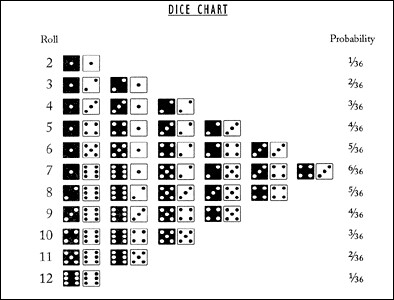
First and foremost is the probability of failure.  At first level, the M-U must roll 9 or better on 2d6 to successfully cast a 1st level spell.  At first glance, it seems OK – but the cumulative probability of rolling 9, 10, 11 or 12 on 2d6 is only 10/36, or 27.8%. [1] For a first level M-U to succeed at casting a 1st level spell less than one third of the time seems unnecessarily difficult.  [edit: since I started writing, Lloyd had the same idea as me, and has changed the table to reflect a base target of 7 – this gives a 50/50 chance on 2d6]

The second point that strikes me is the fact a cost in hp will be levied each and every time and this seems like a recipe for rendering M-U an unplayable class. [2] Using Lloyd’s concept as written, on attempting to cast a first level M-U would have to spend 2hp – succeed or fail.  For a D&D-like game, where M-U characters typically have very low starting hp and poor progression this is far too restrictive.  It’s quite conceivable for a first level character to be unable to cast a single spell without dying from the effort.

Now, looking at these issues it’s pretty obvious to me that the problem is an excess of zeal in limiting just how much spell casting is going to be going on.  Basically, two separate “penalties” (hard to do + spell cost) have been applied and that’s what seems to add up to trouble. 

Luckily, this is very easily tweaked for use with D&D-like games.

First, let’s make it easier: I will keep the table as is, but will allow the M-U’s INT bonus to modify the roll – now, the roll is 2d6+[INT bonus]

Next, I think the hp cost for casting needs to be dumped to make it workable – for a bog-standard M-U with only d4  life is already too dangerous without making the one thing that makes the M-U worth it likely to be fatal.  [edit: Lloyd notes that he is considering reducing the hp cost, but I don’t think that will do it – see below for my approach] Some limitation on the actual number of times M-Us can cast spells is probably required, but hp is far too harsh for M-Us, particularly at low levels. 

I see two ways to replace hp cost as a limiting factor, and which direction one goes in depends on your “philosophy of magic” – is it inherent in the caster, or is it a natural force that the caster is simply channelling/harnessing to create an effect?

Inherent power approach
To replace the hp cost, I propose a new stat – let’s call it Magic - which is part and parcel of any magic-using class.  The score begins at a randomly determined level (I propose 3d6), and rises as levels increase (2/level for pure M-U and 1/level for multiclasses).  It will function as a kind of “magical hit points” that perhaps would have other functions as well – to counter other casters, to forge magic items, that sort of thing. [3]

The caster spends these Magic points just as Lloyd suggests, and they return with rest at some set rate, like healing.  This also has the advantage of retaining the standard M-U requirements for rest.

Force of nature approach
The approach I personally prefer would be to think of “magic” as a force or energy inherent in the world, that magical creatures and magic users are able to harness in some way.  To cast a spell, the M-U must work to gather power in one place and craft it into the “shape” desired.  Mechanically, what this might mean is that the character must perform some ritual or sacrifice [4] in order to generate the necessary power. 

Details are obviously not necessary, so a simple roll each round to determine success/failure in generating a set quantity of Magic would suffice.  I think I would start with 2 Magic per level, and require a d20 roll of the character’s Wisdom or lower to succeed.  [5] In the round in which the necessary power is accumulated, the spell may be cast. 

The force of nature approach has some interesting dimensions to it:

- If it’s a matter of accumulation, and each M-U is able to use sheer force of will to concentrate magical energy and shape it, this opens the door to cooperation – multiple casters working together to gather power (multiply the rate of accumulation by the number of casters) and potentially also adding their skill to the casting itself (highest level caster rolls, +1 per lower-level caster assisting)

- Depending on the nature of the game world, it may be thematically appropriate to link rate of magic accumulation to geography – power spots, leys, etc.

- Material components become potentially more significant – properly prepared materials may serve as a source of additional energy, speeding accumulation (or their lack preventing the accumulation of magic of the right “frequency”)

- If magic is a force, like gravity or magnetism, perhaps it can be manipulated in other ways: magic items that serve as a kind of magical “lens” to increase the rate of accumulation – depending on cosmology, these might work only for certain types of spells (or it might be easier to make such things if they work only for certain types of spells)

- Some magic items might function as “power sinks” or batteries for magical energy – something M-Us can carry around as an instant source of power.

For me, the kind of cosmology I usually use in fantasy games lends itself nicely to the force of nature approach, so this is probably the direction I would go in.

I have no idea when I will get a chance to play around with this, but I know I will be thinking about using it for a game in the not too distant future – thanks to Lloyd for the seeds!

###

1. For reference, see this handy-dandy visualization of the probability of getting a particular result in the 2-12 range using 2d6.

2. I should note that I’m not stuck on “game balance” or anything, just fun – and playing a character that usually fails at the one thing it’s supposed to be able to do doesn’t seem like much fun, particularly if the upshot of failure or success is an early grave.

3. If the points are being spent permanently for anything, the rate of improvement is obviously too low as written – perhaps instead the rates could be modified according to INT bonus, or a “magic die” (like a hit die) could be rolled each time the M-U levels up)

4. I’m thinking here of consumed material components, but there may be something here to make things like animal and human sacrifice mechanically significant – particularly in games where “taint” or similar is an issue.

5. Another option would be to make it a saving throw, or to keep the number of magic points generated per round low but make it automatic unless interrupted.


6. A very interesting tweak to this would be to apply concepts of “power spots” or “leys” to the game world, making it possible for the MU to accumulate power more quickly or perhaps more easily under certain circumstances.

Saturday, 9 May 2015

Prydain Project - map update


Not much change this time - just cleaned up the edges a bit and added colour for contrast.  Eventually, I hope to have time to zoom in and smooth the rivers, which are currently just fractalized lines. But that will be a long, tedious job, and depending on how my enthusiasm waxes and wanes may never happen.

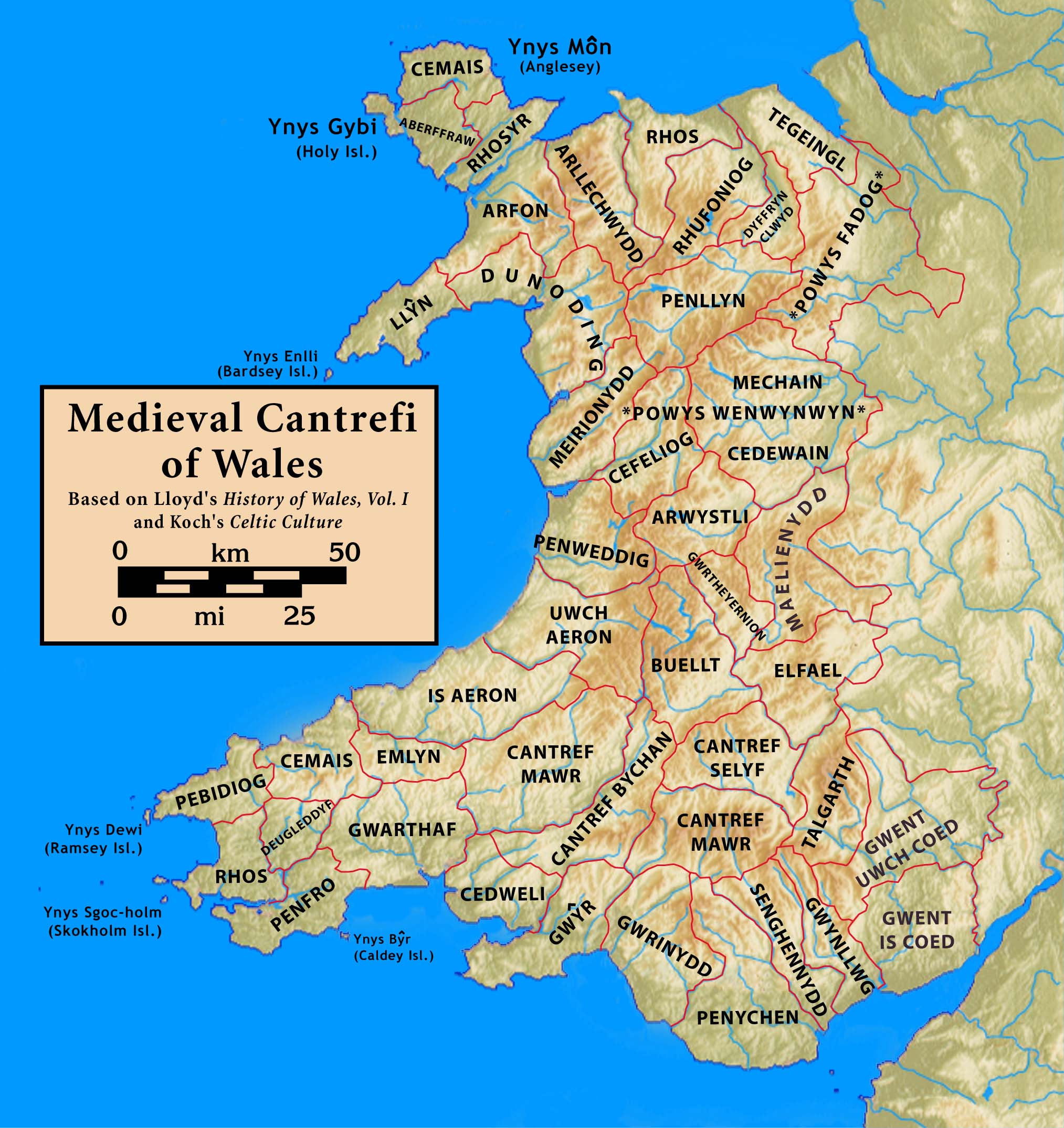
Next up: some political boundaries.  I have been searching, but the best digitized map of cantrefi I could find is the one available at Wikipedia.  What I'll do is use this as a guide ("The Land of Prydain is not Wales...not entirely." Lloyd Alexander) to trace the borders of the cantrefi, and then bring them together into larger kingdoms - the North East mainland for example is where Pryderi's kingdom is supposed to have been, and this will roughly equate to the historical Kingdom of Gwynedd (minus Mona).  Similarly, Caer Cadarn will be the seat of the Kingdom of Glywyssing in the south.  Most of the kingdoms will be "shrunk" to reflect the largely unclaimed nature of Prydain as depicted in the novels.