Mysterious fane on the banks of the Sea of Ohkotsk

Mysterious fane on the banks of the Sea of Ohkotsk
Showing posts with label rules. Show all posts

Thursday, 13 August 2015

Alternatives to Vancian Magic

[ stolen from +Lloyd Neill    ]

See Lloyd’s take here.  You’ll want to look, as I will be referring to the table posted there.


The basic concept:
In a standard “D&D” type fantasy RPG, magic-users “memorize” a limited number of spells which they then cast automatically when they want, but once cast the spells are gone and need to be re-memorized.  Instead, use the cleric “turn undead” table to assign probability of successfully casting a spell – a magic-user can then attempt to cast any spell known, but there is a risk of failure.  On top of this there is a power cost associated with attempting to cast – Lloyd suggests the M-U needs to spend a certain number of hp, based on the level and type of spell, regardless of whether the casting attempt succeeds.

I like the idea.  I like it a lot, actually.  It’s a very interesting take on a way to get away from the “Vancian” magic system inherent in D&D-likes, and I think it’s a better concept than the usual “sorcery” approaches that have been tried in the past.  But I do have a couple of problems with it:

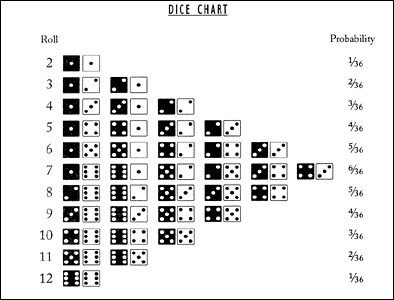
First and foremost is the probability of failure.  At first level, the M-U must roll 9 or better on 2d6 to successfully cast a 1st level spell.  At first glance, it seems OK – but the cumulative probability of rolling 9, 10, 11 or 12 on 2d6 is only 10/36, or 27.8%. [1] For a first level M-U to succeed at casting a 1st level spell less than one third of the time seems unnecessarily difficult.  [edit: since I started writing, Lloyd had the same idea as me, and has changed the table to reflect a base target of 7 – this gives a 50/50 chance on 2d6]

The second point that strikes me is the fact a cost in hp will be levied each and every time and this seems like a recipe for rendering M-U an unplayable class. [2] Using Lloyd’s concept as written, on attempting to cast a first level M-U would have to spend 2hp – succeed or fail.  For a D&D-like game, where M-U characters typically have very low starting hp and poor progression this is far too restrictive.  It’s quite conceivable for a first level character to be unable to cast a single spell without dying from the effort.

Now, looking at these issues it’s pretty obvious to me that the problem is an excess of zeal in limiting just how much spell casting is going to be going on.  Basically, two separate “penalties” (hard to do + spell cost) have been applied and that’s what seems to add up to trouble. 

Luckily, this is very easily tweaked for use with D&D-like games.

First, let’s make it easier: I will keep the table as is, but will allow the M-U’s INT bonus to modify the roll – now, the roll is 2d6+[INT bonus]

Next, I think the hp cost for casting needs to be dumped to make it workable – for a bog-standard M-U with only d4  life is already too dangerous without making the one thing that makes the M-U worth it likely to be fatal.  [edit: Lloyd notes that he is considering reducing the hp cost, but I don’t think that will do it – see below for my approach] Some limitation on the actual number of times M-Us can cast spells is probably required, but hp is far too harsh for M-Us, particularly at low levels. 

I see two ways to replace hp cost as a limiting factor, and which direction one goes in depends on your “philosophy of magic” – is it inherent in the caster, or is it a natural force that the caster is simply channelling/harnessing to create an effect?

Inherent power approach
To replace the hp cost, I propose a new stat – let’s call it Magic - which is part and parcel of any magic-using class.  The score begins at a randomly determined level (I propose 3d6), and rises as levels increase (2/level for pure M-U and 1/level for multiclasses).  It will function as a kind of “magical hit points” that perhaps would have other functions as well – to counter other casters, to forge magic items, that sort of thing. [3]

The caster spends these Magic points just as Lloyd suggests, and they return with rest at some set rate, like healing.  This also has the advantage of retaining the standard M-U requirements for rest.

Force of nature approach
The approach I personally prefer would be to think of “magic” as a force or energy inherent in the world, that magical creatures and magic users are able to harness in some way.  To cast a spell, the M-U must work to gather power in one place and craft it into the “shape” desired.  Mechanically, what this might mean is that the character must perform some ritual or sacrifice [4] in order to generate the necessary power. 

Details are obviously not necessary, so a simple roll each round to determine success/failure in generating a set quantity of Magic would suffice.  I think I would start with 2 Magic per level, and require a d20 roll of the character’s Wisdom or lower to succeed.  [5] In the round in which the necessary power is accumulated, the spell may be cast. 

The force of nature approach has some interesting dimensions to it:

- If it’s a matter of accumulation, and each M-U is able to use sheer force of will to concentrate magical energy and shape it, this opens the door to cooperation – multiple casters working together to gather power (multiply the rate of accumulation by the number of casters) and potentially also adding their skill to the casting itself (highest level caster rolls, +1 per lower-level caster assisting)

- Depending on the nature of the game world, it may be thematically appropriate to link rate of magic accumulation to geography – power spots, leys, etc.

- Material components become potentially more significant – properly prepared materials may serve as a source of additional energy, speeding accumulation (or their lack preventing the accumulation of magic of the right “frequency”)

- If magic is a force, like gravity or magnetism, perhaps it can be manipulated in other ways: magic items that serve as a kind of magical “lens” to increase the rate of accumulation – depending on cosmology, these might work only for certain types of spells (or it might be easier to make such things if they work only for certain types of spells)

- Some magic items might function as “power sinks” or batteries for magical energy – something M-Us can carry around as an instant source of power.

For me, the kind of cosmology I usually use in fantasy games lends itself nicely to the force of nature approach, so this is probably the direction I would go in.

I have no idea when I will get a chance to play around with this, but I know I will be thinking about using it for a game in the not too distant future – thanks to Lloyd for the seeds!

###

1. For reference, see this handy-dandy visualization of the probability of getting a particular result in the 2-12 range using 2d6.

2. I should note that I’m not stuck on “game balance” or anything, just fun – and playing a character that usually fails at the one thing it’s supposed to be able to do doesn’t seem like much fun, particularly if the upshot of failure or success is an early grave.

3. If the points are being spent permanently for anything, the rate of improvement is obviously too low as written – perhaps instead the rates could be modified according to INT bonus, or a “magic die” (like a hit die) could be rolled each time the M-U levels up)

4. I’m thinking here of consumed material components, but there may be something here to make things like animal and human sacrifice mechanically significant – particularly in games where “taint” or similar is an issue.

5. Another option would be to make it a saving throw, or to keep the number of magic points generated per round low but make it automatic unless interrupted.


6. A very interesting tweak to this would be to apply concepts of “power spots” or “leys” to the game world, making it possible for the MU to accumulate power more quickly or perhaps more easily under certain circumstances.

Sunday, 3 May 2015

Out of Alignment

Poking around on the internet for other things, lately I have (completely by chance) come across a number of discussions on the value of alignment (or lack thereof).

Now, personally I have no problem with the idea of alignment, but there seem to be a lot of people out there who think it's a seriously flawed concept, and most of them seem to be particularly incensed by the AD&D system.  I'll grant that even I find that the binomial alignment system of AD&D sometimes results in some fairly arbitrary alliances and antipathies, and the idea of alignment restrictions for classes and races is a little puzzling in some cases - but that's because I cut my teeth on the old Law-Chaos dichotomy in B/X way back in the day.

Make no mistake: for alignment as written in the rules to make sense, you have to buy into the cosmology of the given setting - you have to accept the idea that there are eternal and absolute forces that are woven into the fabric of the world.

In the case of Law-Chaos, you might imagine a constant tension between the creator forces of Law, the gods who gave form to the world and imbued its peoples with civilization, and the forces of Chaos, who are forever trying to dissolve it all back into the primordial murk. This is also the world of Jack Vance's Dying Earth, where the whole of reality is unraveling into strange and inhuman shapes, and things from outside order are constantly pressing at the fabric of the world, trying to get in and impose their own realities on ours.  Even if they're not directly taking part in this struggle, characters are imbued with a driving spark that determines their allegiance, and how their small part in the struggle will count toward the final score.

In the case of AD&D's binomial system reality is far more complex, with mortal reality being essentially the point of contact between other universes that personify certain essential archetypes.  This reality seems more like our own real world, but with supernatural actors occasionally stepping through the veil and working directly on the course of events. In this type of universe, alignment is more of a measure of personality and inclination than of eternal essence or driving spark, but alignment still plays a powerful part in determining allegiances.

Games in these kinds of settings play out in a world of grand, cosmic struggle between opposing forces, and they lend themselves to moral absolutes.  But what about games that don't invoke his kind of mythos?

The argument over alignment usually comes out when people have experience with particular game settings or campaigns in which these kinds of cosmic struggle images don't seem to make sense - games that revolve around court intrigue, or the struggle between factions in a thieves' guild, or just a gritty "real dark ages" kind of game where the goal is more about simulating what the world would have been like if mythological creatures were real than about living out the myths themselves.

The argument stops entirely when you move away from the traditional fantasy RPGs and into other things like SF games, spy games, even superheroes.  In games like these, moral relativity is almost the point: the struggles are obviously more nuanced and complex than "eternal struggle between Law and Chaos" can possibly reflect.

But is alignment really pointless - even a problem - in these kinds of games?

As it happens, I think not.

It seems to me that the alignments - Law or Chaos, good or evil - are themselves arbitrary, as is the decision to define them in terms of diametric oppositions.  There's nothing that says alignments must work this way.  Alignments are about allegiances in an ongoing struggle: the alignment you choose for your character is the crystal from which all other decisions grow. If moral absolutes like good and evil don't make sense in this role for your game world, choose other rallying points.

The key is to select an "alignment" that:

a) can be distilled into a very small number of key words or phrases that convey its essence
b) can serve as a shorthand to be a starting point for a character's personality, attitude and motivations

Once 2 or more alignments have been detailed, the relationships between them will need to be determined as well.  At the simplest level, you could simply sort them in opposed pairs, as was done in the classic AD&D alignment chart.  But why stop there?  Is it necessary for every alignment to have an antipathetic nemesis?  No!  Why not specify relationships like "friendship" "antipathy" and "neutral"?  And consider this: just because A and B are friends, doesn't mean that they share common antipathy toward C.

Take this example:

Imagine a setting arranged like the warring states era of Japanese history - a small number of powerful clans and a larger number of other clans are constantly at war to secure the imperial throne for themselves.  Characters select one clan as their "alignment" to represent which side they're on, and as shorthand to tell them their relationship to the others.  By choosing this clan, the character's basic reasons for action and personality are known, and the rest of the character's personality can be grown from there.  Some of the other clans will be antipathetic, others will be neutral, some will be friendly.

You could perhaps specify that there are 7 clans to choose from, and arrange them at the points of a 7 pointed star - clans at the opposite points are antipathetic, those adjascent are friendly, all others are neutral.

With the stroke of a pen, a fairly complex political and social reality is created that guides characters' actions and interactions without needing to resort to cosmology.

(note: a set-up very similar to this is used in the game Legend of the Five Rings - they use the conceit of assigning animal totems to each of the clans, and the "essence" of that animal provides guidance as to the common theme among members of the clan, and the clan's relationship with the other clans)

A second example:

Court intrigue in a fantastic Britain at the time of Elizabeth I - the Faerie Queen. Those loyal to the Queen defend the realm from a variety of intrigues set on deposing her for various reasons and installing a sympathetic regime of their own.

In this case, "The Realm" is one alignment, and there are several others in antipathy to it - perhaps "the Commons", "the Spanish", "the Church" and "the Usurper" - but what are the relatonships among them? Some will be neutral, able to work together to undermine the Realm, yet probably also scheming to make sure their favourite is the one to sit on the throne.  In other cases, they will have antipathy among themselves as well as toward the Realm, and will spend as much time trying to destroy each other as anything else.

I would probably use this approach if trying to put together an alignment system for use with a SF game, something like Dune.

A final example, and one that is easy to implement in any fantasy game:

Quite simply - use the elements as alignments.

Replace the whole good/evil style of cosmology with a more essentialist one.  Each character is "allied" to one of the elements, and as such has resonance with them.

The options are multitudinous - one you start thinking about them, you will probably find essential motivating forces that are perfect for your game.

Tuesday, 30 September 2014

Legendary Weapons Old and New

A blade is a blade is a blade, yes?

No.

Some weapons are indeed forged in factory fashion, intended for the armories of keeps or to put teeth into a rag-tag force of conscripted farmers.

Some weapons are “off the rack” as it were, work-a-day tools in the kit of professional soldiers.

But some weapons…

Some weapons are great.

Some weapons were forged in circumstances mysterious or arcane. 

Some are artworks, the life’s work of a great master of the forge.

Some weapons were forged amid blood and fury – more birthed than made.

Yes, some weapons are great.

These legendary blades are storied – at times their names are remembered long after those of the warriors who wielded them.  It seems as though it was the weapon itself that wrought great deeds, as though the weapon was the hero – or the villain – that shook the world.

And sometimes it was.

Such weapons may be lost, but they will be found again: and when they are found, there will once again be great deeds to be sung.

###

[Inspired and informed by the article "A New Approach to Magic Weapons" by Michael Williamson, published as the Treasure Chest column in White Dwarf issue #73 (Jan 1986).]

Legendary Weapons Old and New

Part 1 : Determine the point value of the weapon

(random or choose):

Forging
Legendary Smith (1d10)

History
Age: 1 per 20 years (10d100)
Deeds:
+1-5 for each major event in which the weapon played a notable part (1d5/20 years)
+10 for any great events in which the weapon was a major player (10% chance per 100 years)
Wielders:
            + 1 per 3 levels of wielder if weapon was favoured for the major part of career (1d10/100 years)

Special
Add for dramatic circumstances of forging (1d10)
Magic weapons add +10 per +1 or special power (flaming, slaying, etc)

Sum the above to get weapon point value total.

Alignment
Legendary weapons are very focused and thus have only 4 primal alignments.  Select based on history or roll 1d4:
1. Good
2. Evil
3. Law
4. Chaos

Legendary weapons are not aligned in the magical sense, so can be wielded by anyone – but more powerful weapons may well detect as their alignment where appropriate.

Purpose
Legendary weapons are infused with a sense of purpose.  Roll or select according to what is appropriate for the weapon’s history:

Roll
Good
Law
Chaos
Evil
1
Defend the weak
Defend the law
Defend freedom
Defend oppression
2
Destroy a force for evil
Destroy a criminal society
Destroy an institution
Destroy a force for good
3
Fight cruelty
Maintain stability
Foment anarchy
Create fear/hardship
4
Kill all evil beings
Kill all criminals
Kill all officials
Kill all good beings

(Most entries will need to be detailed according to the setting: for example, destroy a force for evil might be interpreted to mean the weapon’s purpose is to destroy the followers and temple of a particular evil god. Destroy an institution might mean the weapon’s purpose is to kill all members of a particular aristocratic lineage, or it might mean the weapon is working against the institution of slavery)

Name
All legendary weapons have names.  In some cases the name will be inscribed on the weapon itself or on a special case, but in others the name may be unknown in which case the services of a sage or diviner may be required.  Detect magic will identify the weapon as very special, but not reveal the name or properties.  Spells such as Speak With Dead (to ask the former owner) or spells that access knowledge from the outer planes may reveal the name, or knowledge as to where it may be found.  Information found by a sage may be fragmentary, or may only point to where the name may be learned (i.e. triggering a quest to learn more about the weapon and unlock its power).  Intelligent weapons may be able to communicate their names to their wielders, but may or may not be inclined to.

Part 2 : Using the weapon

Weapons infused with the power of their history and great deeds have names and can be called upon to aid the wielder in times of trouble.  The wielder calls out the name of the sword and rolls to attack as normal.  Only a single attack is possible.  If the attack results in a hit vs target AC, but the target requires special weapons to hit, subtract points from the weapon as follows:

1pt silver
2pt magic weapons
2pt/+1 for targets that require specific bonus to hit

Roll damage as usual, then subtract points from the weapon at 1pt per additional hp damage required to kill the target until the weapon’s current point value reaches zero.

The sum of the points spent is the % chance the weapon will break (-5% per magical plus or special power, e.g. flaming, vorpal)

Recharging
The weapon will regain points up to its maximum as determined in part 1 at a rate of 1pt per 2hp damage dealt in the service of its purpose – random fights do not regenerate the weapon’s points, but if the wielder is working toward a goal that matches the weapon’s purpose hp dealt in fights directly related to that goal will do so.

Empowering
If the wielder consistently favours the weapon while pursuing goals that are in line with the weapon’s purpose, when a major goal is achieved (i.e. plot impact is high, challenge was high) the weapon may gain 1-5 points.  The weapon also gains 1pt for every 3 levels the wielder gains while using it as a favoured weapon.  These points add to the weapon’s max total.

Part 3 : Special features

As legendary weapons gain in power, they may evolve and develop additional powers.  For each 10pt of power, roll 3d6 once on the following table:

3        Special power: 3d6 lightning
4        Special power: either flaming (1-3) or frost (4-6)
5-6     Special power: defending (any magical bonus can be assigned to AC instead)
7-13   Add magical +1
14-15 Speaks (if no INT score, will communicate only animal urges in favour of purpose, calculate Ego to
                        determine wielder’s ability to resist)
16      Special power: Intelligent: add 1d4 INT
17      Special power: Persuasive: add 1d4 CHA

18      Special power: Extra Ego: add 1d4 to Ego score